
Quick Verdict
If you're expecting this guide to end with "buy the GasGas SM 700 if you're on a budget, buy the Husqvarna 701 Supermoto if you want the best," it won't — because that's not really what's going on here.
Strip away the bodywork and these two share the same 692.7cc LC4 engine architecture, the same chromoly trellis frame concept, the same WP suspension, and nearly identical geometry. They're built on the same platform Pierer Mobility uses across GasGas, Husqvarna, and KTM.
The honest short answer: the Husqvarna is the newer, more updated machine — 2026-spec engine, four ABS modes, an optional quickshifter, spoked wheels, and a full four-year warranty — for about $700 more. The GasGas is the last confirmed U.S. spec sitting a generation behind on electronics, but it's lighter, cheaper, and wears a livery a lot of riders simply prefer. If the spec sheet doesn't decide it for you, the rest of this guide is about what does.
Platform Lineage: Why These Two Look So Alike
Neither of these bikes is a secret. Since Pierer Mobility (KTM's parent company) acquired GasGas in 2019, GasGas's street-legal models have been built on KTM's existing 690-based single-cylinder platform — the same platform underneath the Husqvarna 701 Enduro/Supermoto and the KTM 690 Enduro R/SMC R. GasGas's SM 700 and ES 700, introduced in 2022, were the brand's first-ever street-legal motorcycles, and Husqvarna's 701 lineup has been built on this shared architecture since 2016.
None of that is a secret, and it's not really a knock on either bike — it's standard practice across the industry for a parent company to spread platform costs across sister brands. What it does mean is that a straight spec-sheet comparison between the SM 700 and 701 Supermoto is going to look a lot closer than a typical "Brand A vs Brand B" shootout. The real differences live in the details.
Design & Visual Character
This is where the two bikes genuinely part ways, and it's arguably the biggest reason to pick one over the other.
The GasGas SM 700 wears the brand's "Red Hot" identity — fluorescent red bodywork, black accents, and a design language borrowed straight from GasGas's motocross and off-road racing heritage. It looks aggressive and a little unruly, which fits GasGas's positioning as the scrappier, racing-rooted member of the Pierer family.

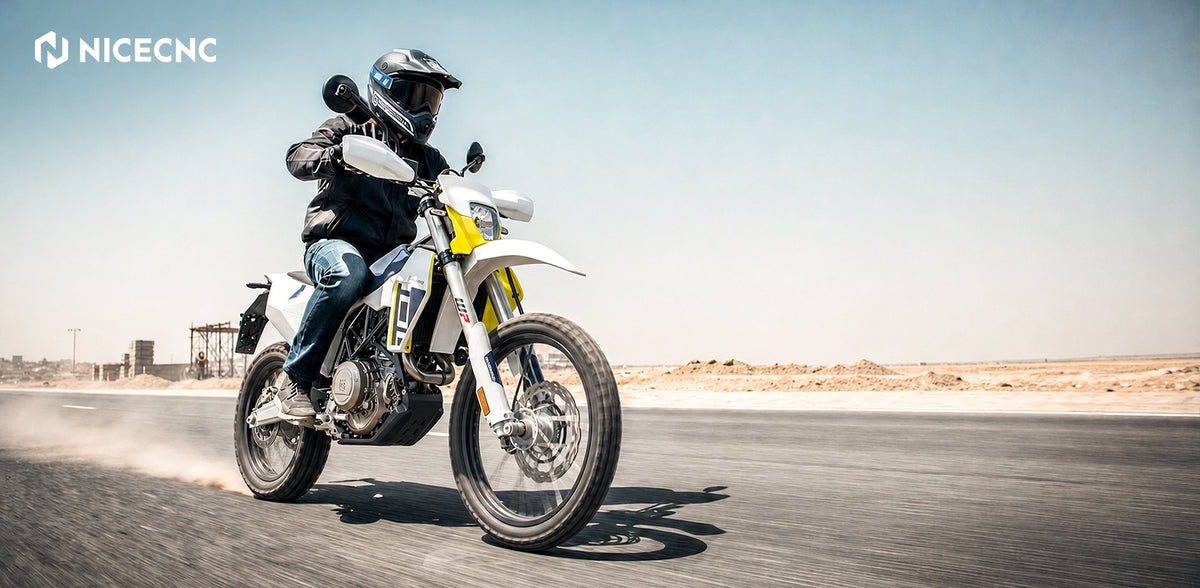
The Husqvarna 701 Supermoto goes the opposite direction. Its white-and-blue livery, black anodized wheels, and minimalist bodywork reflect Husqvarna's Swedish-inspired design language — restrained, premium, almost architectural next to the GasGas. Husqvarna has leaned harder into this "progressive design" identity across its whole street lineup, and the 701 Supermoto's updated bodywork and extended seat for 2026 continue that direction.

Neither is more "correct." One reads as a race-bred street hooligan, the other as a design object that happens to wheelie. Which one you find yourself staring at in the dealership is a genuinely useful signal for which bike you'll actually enjoy owning.
Performance Specifications
| Spec | GasGas SM 700 (2024/2025 MY) | Husqvarna 701 Supermoto (2026 MY) |
|---|---|---|
| Engine | 692.7cc single-cylinder, liquid-cooled, SOHC 4-valve | 692.7cc single-cylinder, liquid-cooled, SOHC 4-valve |
| Power | 55 kW / 74 hp @ 8,000 rpm | 58.1 kW / 79 PS |
| Torque | 73.5 Nm @ 6,500 rpm | 73 Nm |
| Bore x Stroke | 105 x 80 mm | 105 x 80 mm |
| Transmission | 6-speed, APTC slipper clutch | 6-speed, PASC slipper clutch, optional Quickshifter+ |
| Frame | Chromoly steel trellis, powder-coated | Chromoly steel trellis, powder-coated (revised, stiffer for 2026) |
| Front suspension | WP APEX 48mm, 215mm travel | WP APEX 48mm open-cartridge, 224mm travel |
| Rear suspension | WP APEX Pro-Lever linkage, 240mm travel | WP APEX Pro-Lever linkage, 240mm travel |
| Front / rear brake | Brembo 4-piston radial, 320mm / Brembo 1-piston floating, 240mm | Brembo 4-piston radial, 320mm / Brembo 1-piston floating, 240mm |
| ABS | Bosch 9.1 MP, cornering ABS + Supermoto mode (disengageable) | Bosch, 4 modes: Road / Sport / Supermoto / Supermoto+ |
| Wheels | 17" cast aluminum, 10-spoke | 17" spoked, black anodized, tubeless |
| Tires | Continental ContiAttack SM EVO, 120/70-17F / 160/60-17R | Continental ContiAttack Supermoto, 120/70-17F / 160/60-17R |
| Wheelbase | 1476 mm | 1476 ± 15 mm |
| Seat height | 898 mm | 899 mm |
| Ground clearance | 237 mm | 237 mm |
| Weight (without fuel) | 148.5 kg | 152 kg |
| Fuel tank | 13.5 L | 13.5 L |
| Fuel consumption | ~4.1 L/100km (WMTC) | ~4.1 L/100km (WMTC) |
| MSRP (U.S.) | $12,699 + $750 destination | $13,399 + $800 freight |
Look closely and the table tells its own story: nearly every core dimension — wheelbase, ground clearance, tank size, fuel economy, brake hardware — is identical or within rounding error. That's the shared platform showing through. The real deltas are concentrated in three places: the Husqvarna's slightly newer, slightly more powerful engine tune; its longer front suspension travel; and its noticeably deeper electronics package.

Setup & Ergonomics: Where the Twins Actually Differ
A few details separate these bikes once you get past the shared numbers:
Wheels
The GasGas rolls on cast aluminum wheels; the Husqvarna uses spoked, tubeless wheels. Cast wheels are marginally lighter and need zero maintenance, but spoked wheels are the more forgiving choice if you're going to be curb-hopping, hitting the occasional pothole hard, or riding aggressively enough that a bent rim is a real possibility — spokes flex a little before they fail, cast wheels tend to crack.

Suspension travel
The Husqvarna's fork offers 224mm of travel to the GasGas's 215mm, and Husqvarna's 2026 update specifically re-tuned the WP APEX fork's open-cartridge internals for supermoto use. It's a small number on paper, but combined with the updated valving, expect the Husky to feel marginally more composed over rough pavement and curbs.
Electronics and rider aids
This is the widest gap between the two. The 2026 Husqvarna offers three ride modes (Street, Sport, and optional Track — with Launch Control, Anti-Wheelie, and Motor Slip Regulation), four distinct ABS settings including a dedicated Supermoto+ mode for controlled rear-wheel slides, an optional Quickshifter+, and app connectivity with turn-by-turn navigation. The GasGas's last confirmed spec offers two ride modes (Street and Supermoto) and cornering ABS with a disengageable Supermoto setting — capable and genuinely fun, but noticeably less configurable than what Husqvarna now ships.

Engine tune
Both share the same 692.7cc bottom end, but Husqvarna's 2026 update brought redesigned crankcases to reduce drag, revised valve timing for more low-end torque, a relocated catalytic converter, and extended service intervals (15,000km oil changes vs. the GasGas's shorter interval on its older-generation tune). The horsepower gap on paper — 74 vs. 79 — is small enough that most riders won't feel it directly, but the Husky's engine is simply the newer piece of hardware.
Real-World Riding Scenarios
Because the spec sheet is this close, what actually separates these bikes is how they feel in the situations you'll put them in.
Technical canyon roads:
The extra 9mm of front travel and revised 2026 fork valving should give the Husqvarna a slightly more planted, controlled feel through fast direction changes and mid-corner bumps. The GasGas isn't behind by much — the geometry is nearly identical — but expect the Husky to feel a touch more buttoned-down when you're really pushing.
Track days:
This is where the Husqvarna's electronics package earns its keep. Optional Track mode with Launch Control and Anti-Wheelie, plus the Quickshifter+ option, are genuinely useful on a circuit in a way they simply aren't on the street. The GasGas's simpler two-mode setup is still plenty capable for a track day, but you're doing more of the work yourself.

City commuting:
Nearly a wash. Seat heights sit a millimeter apart, both bikes are light and narrow enough to filter through traffic, and both share the same low-effort slipper clutch. The GasGas's roughly 3.5kg weight advantage (without fuel) is the kind of thing you might notice stopping and starting at lights, but it's marginal.
Longer rides:
Neither bike is built for distance — supermotos rarely are — but the Husqvarna's updated, extended seat and app-based turn-by-turn navigation give it a slight edge if you're the type to string a few hours together. Both share the same 13.5-liter tank and near-identical fuel economy, so range isn't a differentiator.
Who Should Buy Which
Buy the GasGas SM 700 if:
You're drawn to the racing-rooted, no-frills character and the "Red Hot" styling, you don't need the extra ride modes or a quickshifter, and the roughly $700 price gap (plus the wider availability of leftover 2024/2025 stock) matters to your budget. It's a very capable, very fun bike — just carrying a generation-older electronics suite.

Buy the Husqvarna 701 Supermoto if:
You want the current, fully updated version of this platform — the newer engine tune, the deeper electronics package, the optional quickshifter, spoked wheels, and Husqvarna's four-year Premium Manufacturer's Warranty — and Husqvarna's minimalist design language speaks to you more than GasGas's racing livery. You're paying a modest premium for a bike that's simply more current.

Either way, you're buying into the same proven single-cylinder supermoto platform that's underpinned this segment for years — the decision genuinely does come down to which identity and which spec sheet you'd rather live with.